

Five Basic Reasons Student Visas Get Refused And How Students Can Avoid Them By Ori Connect
Studying abroad is a major investment of time, money, and expectations. Receiving an admission or acceptance letter is an important achievement, but it does not automatically guarantee a student visa. Visa officers assess whether the applicant genuinely intends to study, has sufficient and credible financial resources, has provided authentic documentation, and meets the immigration rules of the destination country.
Recent immigration data also shows why students should take the visa stage seriously. Canada reported a 59% refusal rate for new study permit applications in 2025, compared with 52% in 2024; by January 31, 2026, the new study-permit refusal rate had reached 62%. In the UK, ICEF Monitor, citing Home Office/Nous Group data, reported that the sponsored study visa refusal rate for Pakistani applicants reached approximately 41% in the six months covering Q4 2025 and Q1 2026, compared with just under 6% in the comparable 2024/25 period.
These numbers do not mean that every student from a particular country has a high risk of refusal. They demonstrate that visa scrutiny is becoming increasingly important, particularly where applications contain weaknesses in finances, study rationale, documentation, or credibility.
Here are five of the most common refusal areas students should understand before submitting an application.
- Weak or Unconvincing Financial Evidence
Money is one of the most important parts of a student visa application.
The applicant must demonstrate that the education and living expenses can realistically be paid. A visa officer may look beyond the final bank balance and examine whether the funds are genuine, accessible and consistent with the sponsor’s income and financial history.
For example, a large amount deposited into an account immediately before a visa application can create questions about the source of funds. Australia explicitly advises applicants relying on financial capacity to demonstrate genuine access to the money, including evidence explaining the source of deposits and, where relevant, evidence of salary income, business activity, loans or the relationship with a financial supporter. Australia also states that simply providing a single-day bank balance does not establish how the funds were accumulated.
ORI Connect Advice: Do not focus only on the bank balance. Build a clear financial story: who is sponsoring the student, how the sponsor earns the money, where the funds came from, how tuition will be paid, and how living expenses will be covered.
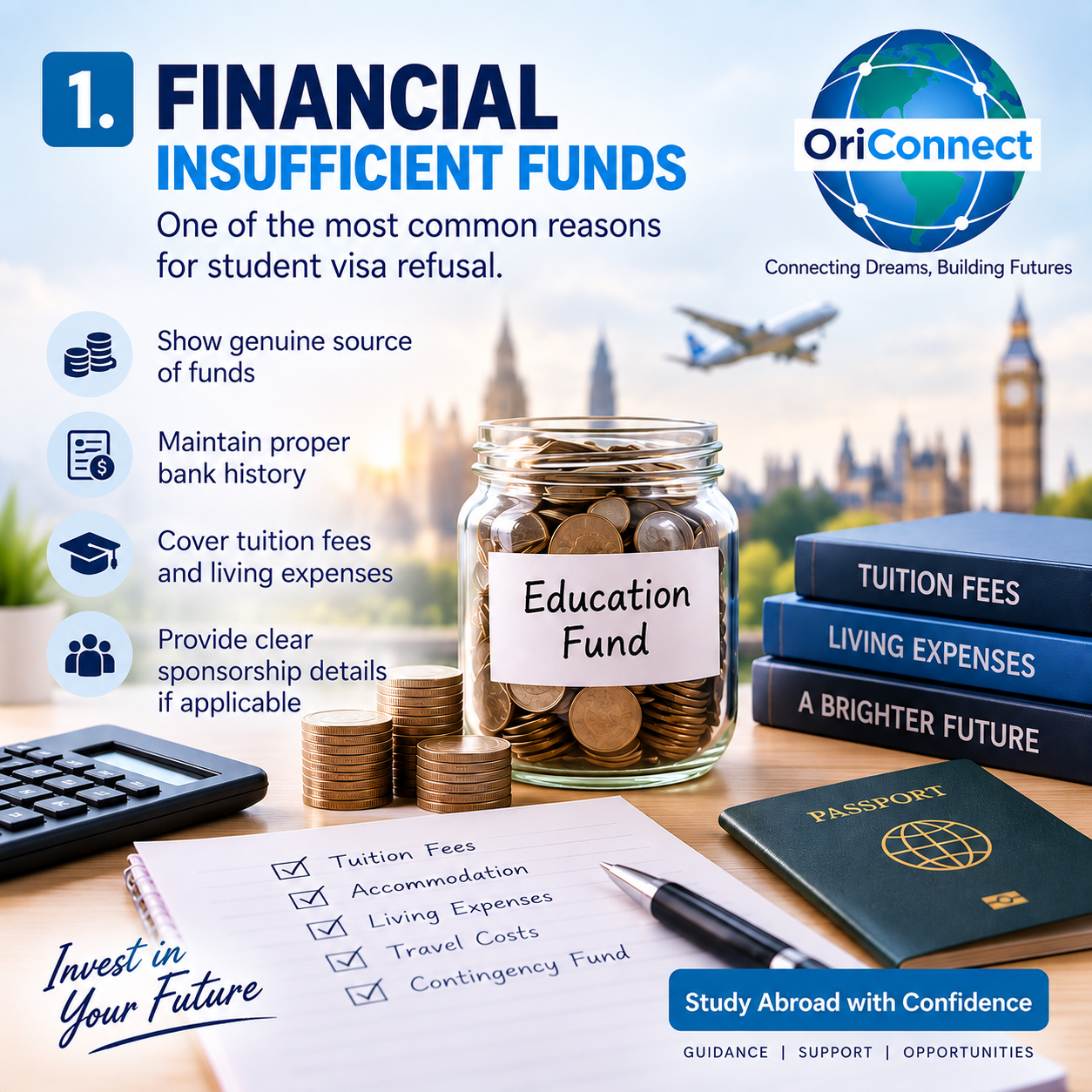
Financial preparedness is an essential part of a successful student visa application. Clear, genuine, and properly documented funds help demonstrate your ability to manage tuition fees and living expenses while studying abroad.
- Weak Study Purpose or Poor Academic Progression
A student should be able to explain why this course, why this university, and why this country.
A common weakness occurs when the proposed course does not logically follow the student’s previous education or professional experience. For example, a student with a strong background in one field suddenly applying for an unrelated programme without a convincing explanation may face additional scrutiny.
Australia’s Genuine Student framework specifically considers the applicant’s circumstances, previous immigration history and reasons for choosing the course and provider. Applicants are asked to explain why they want to study the particular course and how completing it will benefit them. Australia also considers why an applicant is not studying a similar course in their home country where one is available.
Canada similarly states that a study-permit application can be refused where the applicant fails to convince the officer that their main purpose is to study or that they will leave Canada at the end of their authorized study period.
The lesson is simple: an admission letter is not the same thing as a convincing study plan.
ORI Connect advice: Students should prepare a coherent academic narrative covering their previous education, proposed programme, university selection, career objectives and the practical value of the qualification.
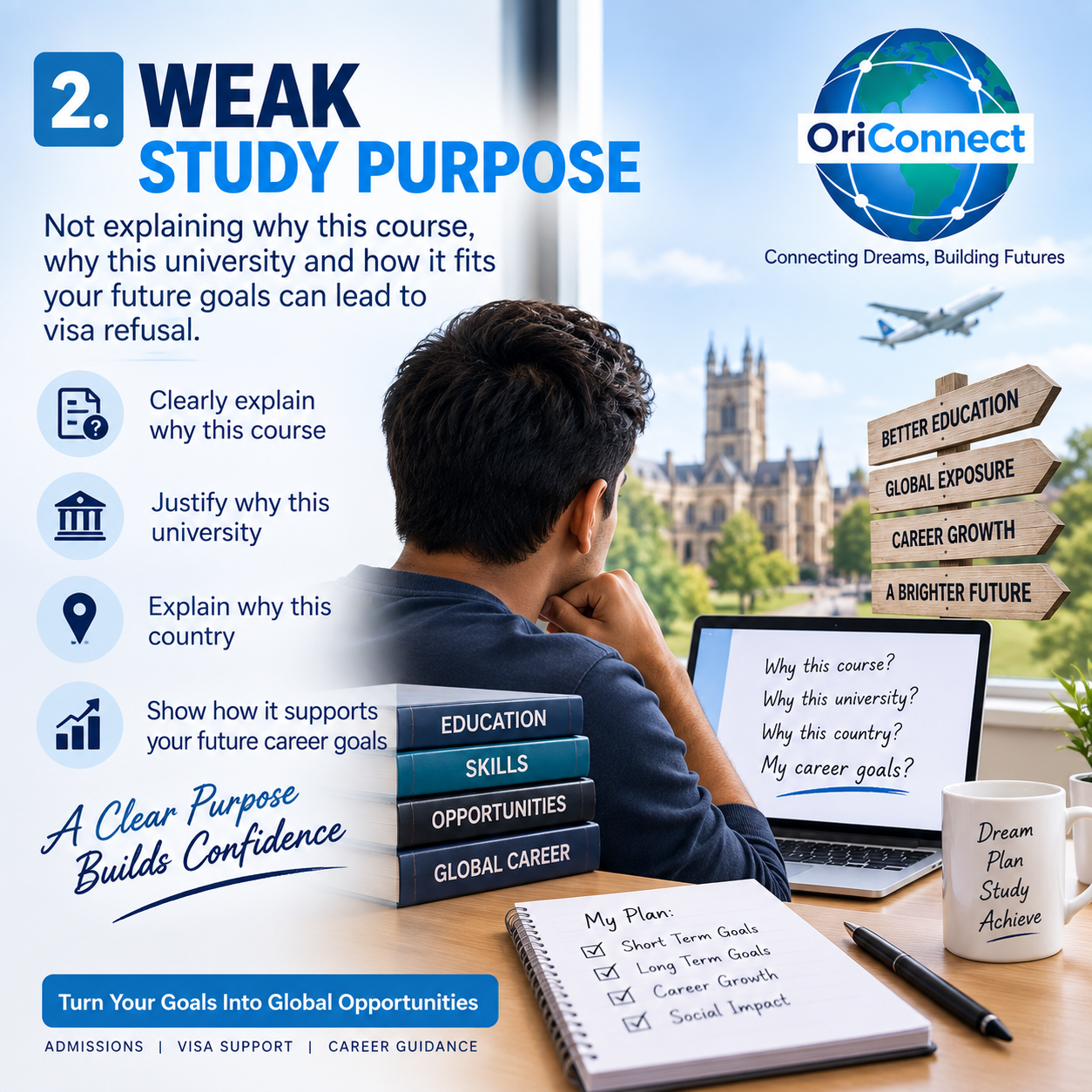
A clear and genuine study purpose is an important part of a strong student visa application. Students should be able to explain why they chose their course, university, and study destination, and how the program connects with their future academic and career goals.
- Inconsistent, Incomplete or Unverifiable Documents
A visa application is only as strong as the evidence supporting it.
Problems can arise from missing educational documents, inconsistent dates, unexplained study gaps, incorrect information, mismatched names, questionable financial documents, incomplete translations, or discrepancies between the application form and supporting documents.
Immigration authorities are also strengthening verification systems. Canada, for example, introduced direct verification of Letters of Acceptance with designated learning institutions. IRCC reported that it verified more than 368,000 letters of acceptance in 2025, with about 1.3% producing “no-match” results; many were subsequently resolved, but others were withdrawn or refused.
Students should therefore never treat a document as “just paperwork.”
ORI Connect advice: Every document should tell the same story. Names, dates, educational history, employment, finances, travel history and family information should be checked for consistency before submission.
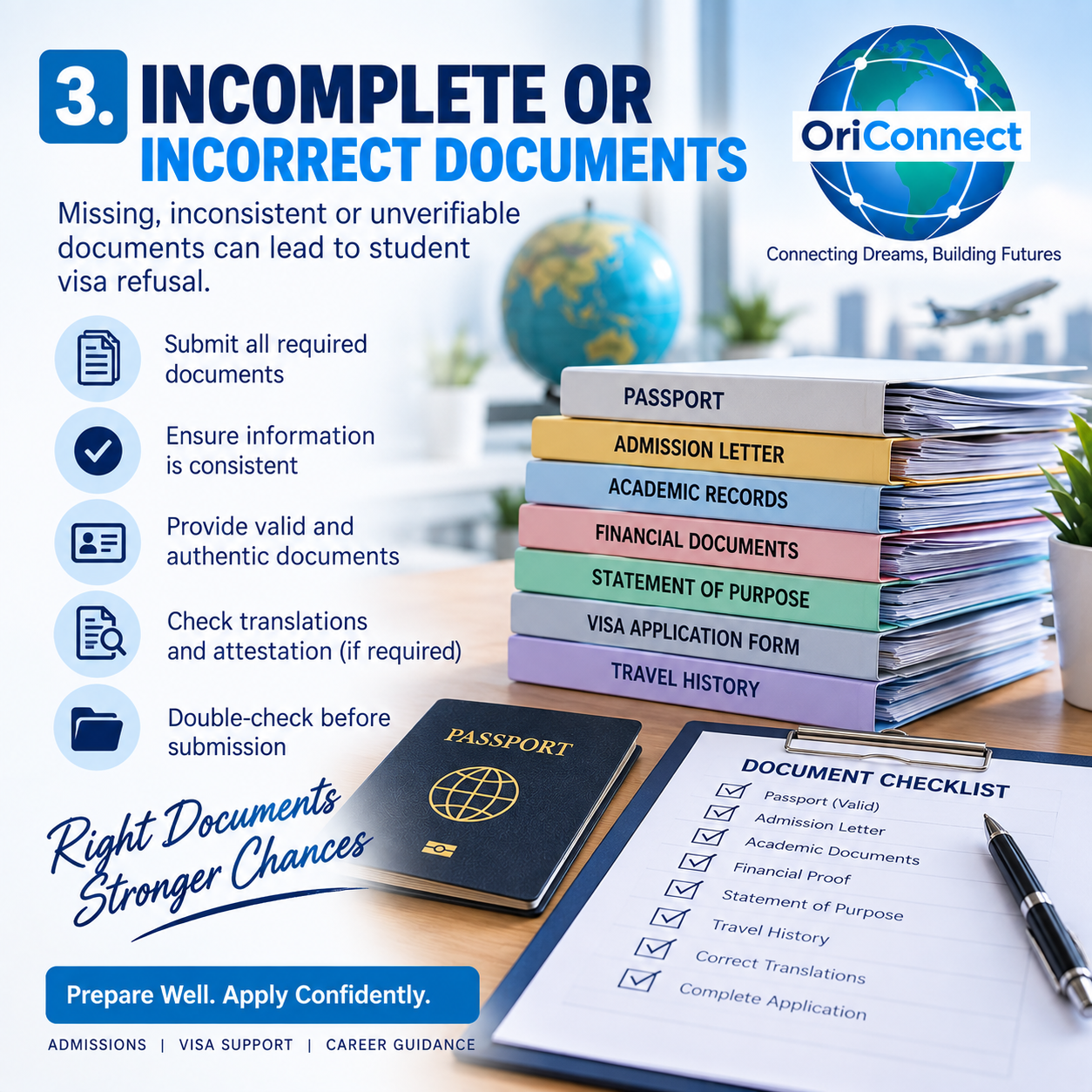
Complete Documentation, Stronger Applications. Avoiding common document errors is an essential step toward a smooth student visa journey.
- Doubts About Genuine Student Intent
A student visa is fundamentally a study visa. Officers need to be satisfied that education is the genuine purpose of the journey.
This does not mean a student can never have future career or immigration ambitions. Different countries apply different rules, but a student should be able to demonstrate that the proposed education is credible and that they understand the conditions of the visa.
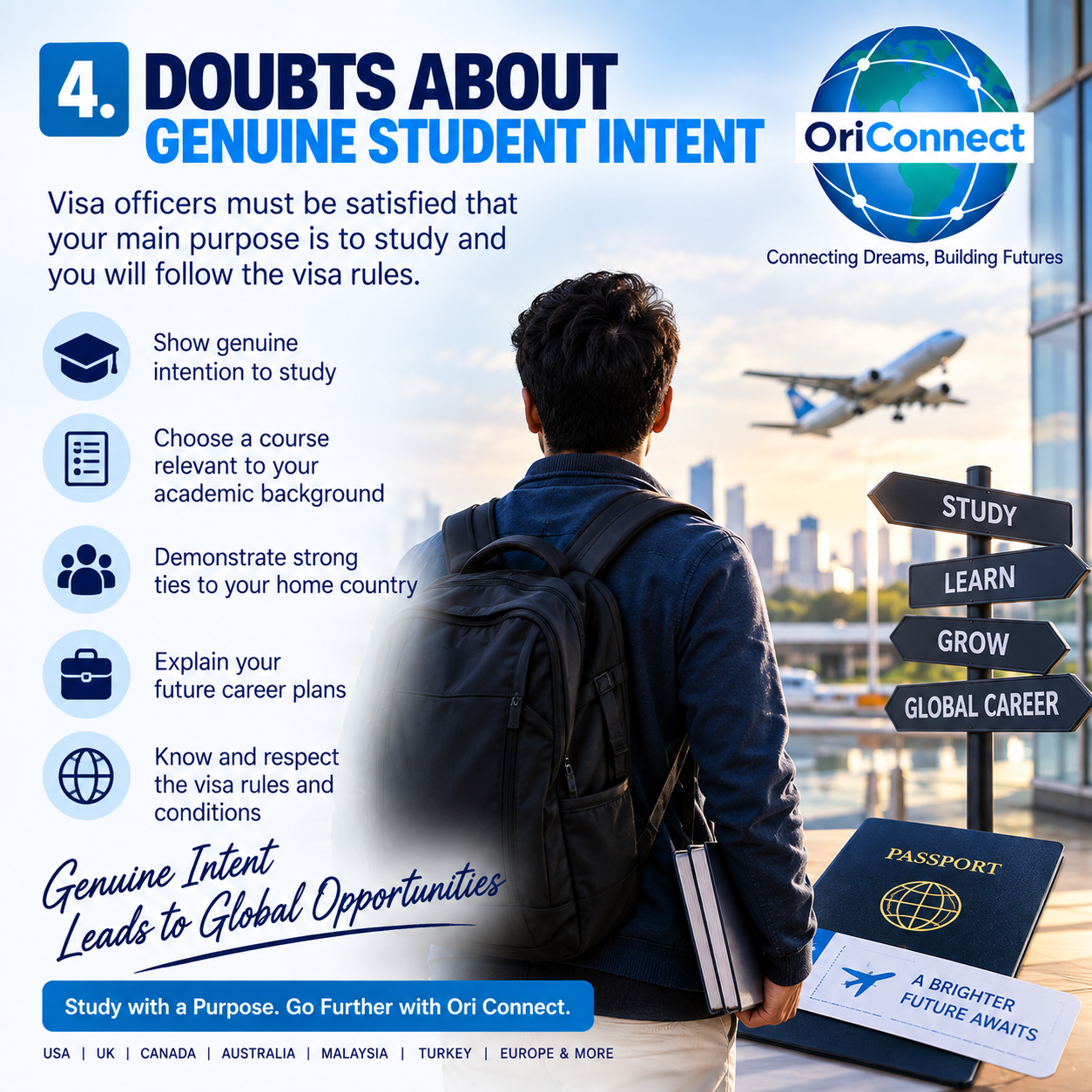
Understanding the key factors behind student visa refusals can help applicants prepare stronger, more complete applications and avoid common mistakes.
The United States provides a clear example. Under INA Section 214(b), nonimmigrant visa applicants are presumed to have immigrant intent unless they demonstrate that they qualify for the relevant nonimmigrant category and overcome that presumption. The U.S. Department of State identifies factors such as employment, home and family relationships as examples of ties that cequest evidence of the student’s academic preparation, intention to depart after the course and ability to pay educational, living and travel expenses.
ORI Connect advice: Students should know their programme. They should understand the university, tuition fees, course structure, location, accommodation arrangements and career relevance. Memorized interview answers are not a substitute for genuine knowledge.
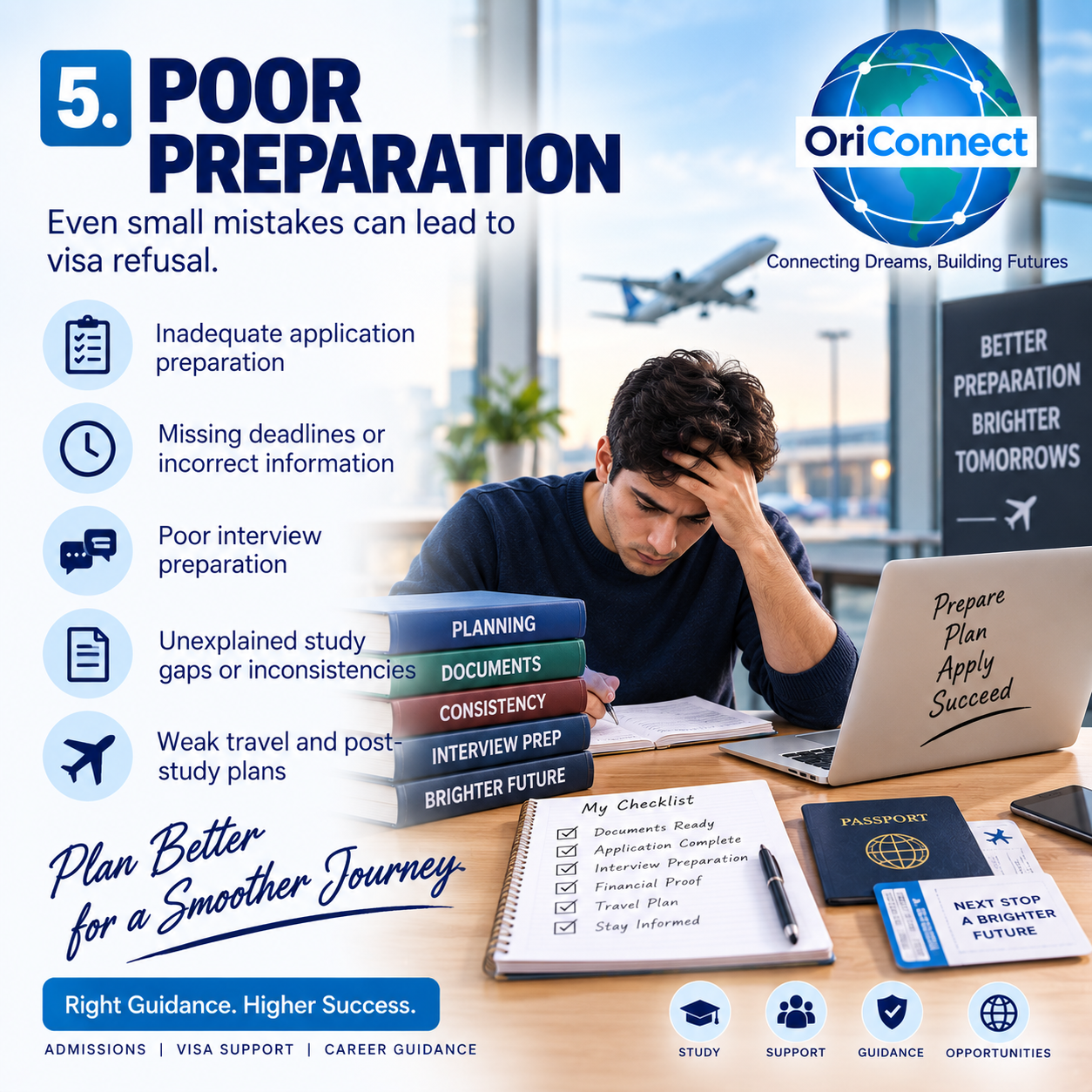
- Poor Preparation for the Overall Visa Application
Sometimes an application is not refused because of one dramatic mistake. Instead, several smaller weaknesses combine to create an unconvinced application.
Examples may include inadequate financial evidence, unexplained study gaps, weak statements, incomplete travel arrangements, poor interview preparation, an unexplained change of academic field, or documents that do not adequately support the applicant’s statements.
Research into international student decision-making also shows how important visa uncertainty has become. IDP’s Emerging Futures research has reported that visa policies, application fees, processing times and rejection rates increasingly influence students’ destination decisions. ICEF’s 2026 Agent Voice survey, based on 1,225 agents across 113 countries, likewise identified affordability and visa processes among the major factors influencing international students’ choices.
This means professional preparation should start before the visa form is submitted not after a refusal.
A well-defined study purpose helps demonstrate why a particular course, university, and destination align with the student’s academic background and future career goals.
A successful student visa application is not simply a collection of documents. It is a consistent and credible case supported by evidence.
The five areas students should check carefully are:
Financial capacity → Academic progression → Genuine documentation → Genuine student purpose → Overall preparation
There is also an important distinction between visa refusal rates and individual refusal risk. Statistics such as Canada’s 59% new study-permit refusal rate in 2025 or recent UK refusal trends among Pakistani applicants describe populations of applications; they do not predict the outcome of a particular student’s case.
At ORI CONNECT. our approach is to assess the student’s profile before submission, identify weaknesses, organize supporting evidence, and make sure the academic, financial and personal story is consistent throughout the application.
A strong admission profile deserves a strong visa application.
This article is for general educational information only. Visa rules, documentary requirements and refusal rates can change by country, programme, nationality and time period. Students should always check the current requirements of the relevant immigration authority, embassy/consulate and institution before applying.
Sources and research: UK Visas and Immigration; Government of Canada/IRCC; Australian Department of Home Affairs; U.S. Department of State; IDP Emerging Futures; ICEF Monitor/Agent Voice.